Effects of Smoking and Secondhand Smoke on the Fetus and the Nasal Cavity During Preconception and Pregnancy
Preconception and pregnancy are often understood as "eat more, stay up less, get checkups." The risks associated with tobacco are often glossed over with a single sentence: "Anyway, I don't smoke much" or "I don't smoke myself, so it's fine if someone next to me smokes." In reality, the nicotine, carbon monoxide, particulate matter, and a large number of irritating chemicals in smoke can both affect the fetus through the maternal blood and placenta, and directly wash over the pregnant woman's nasal mucosa, which is already more prone to congestion and edema.
This article is intended for preconception couples and pregnant women's families. It clearly explains the effects of active smoking, secondhand smoke (and briefly touches on thirdhand smoke) on the **fetus** and the **pregnant woman's own nasal cavity**, and provides actionable smoke-avoidance advice. Serious, but not frightening; it discusses risks, but also protective actions that can be taken immediately.
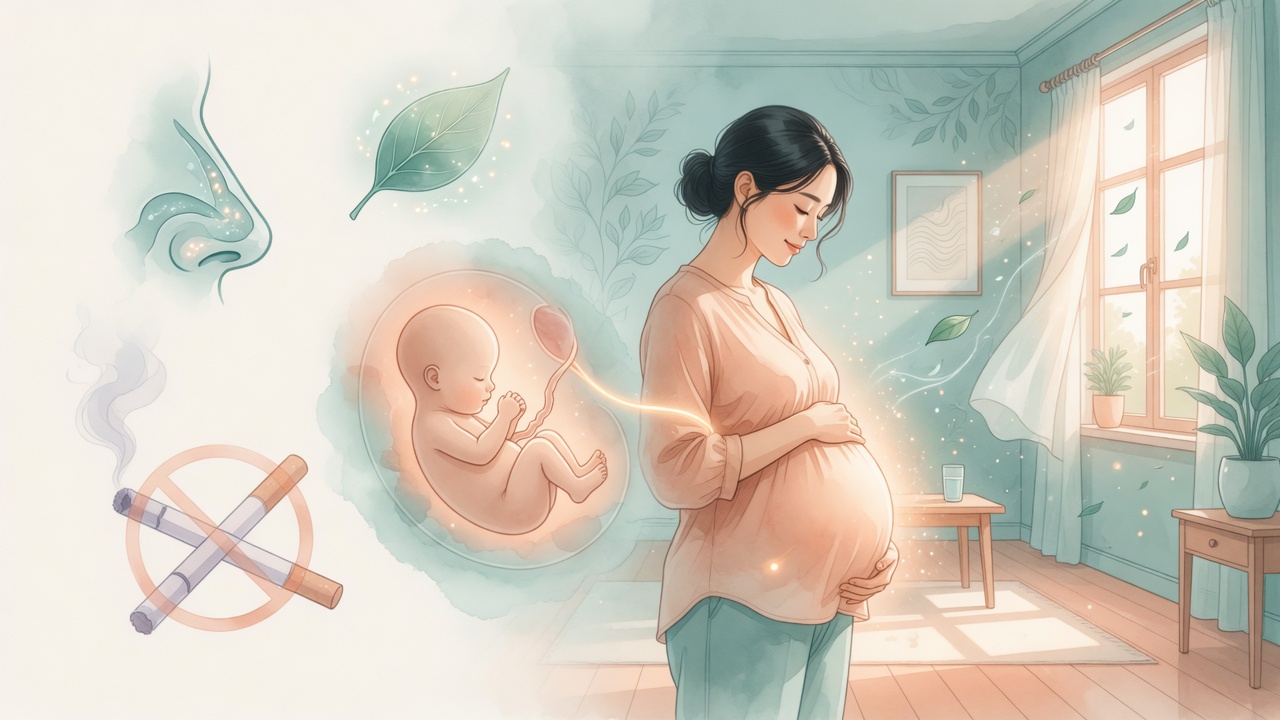
I. Preconception and Pregnancy: Two Overlapping Sensitive Windows
From a health management perspective, the tobacco problem is not only important from the day a pregnancy test comes back positive.
1. Preconception Stage: Eggs, Sperm, and Early Intrauterine Environment
Egg maturation, sperm quality, fertilization, and implantation are all relatively sensitive periods to oxidative stress and toxic substances. Long-term smoking by either partner means loading the reproductive cells and the internal environment that early embryos may depend on with harmful exposure before "seeing two lines." Quitting smoking during preconception essentially moves the protection window forward.
2. First Trimester: The Critical Period of Organogenesis
The first trimester is the peak period for the formation of major organ systems. At this time, placental function is still being established and perfected, making harmful substances in the maternal blood more likely to interfere with embryonic development. The association between smoke-related exposure and adverse pregnancy outcomes has been repeatedly discussed in public health and clinical observations—including directions such as elevated miscarriage risk, placenta-related issues, and fetal growth restriction. There is no need to equate every brief exposure with "definitely causing harm," but **regular exposure is by no means a negligible background noise**.
3. Second and Third Trimesters: Growth, Oxygen Supply, and "Programming"
In the second and third trimesters, the fetus grows rapidly, requiring higher placental perfusion and oxygen delivery. Carbon monoxide reduces the effective oxygen-carrying capacity of hemoglobin. Nicotine and related vascular reactions may affect uterine–placental blood flow, putting the fetus in a relatively "supply-demand imbalance" state more easily. At the same time, intrauterine smoke exposure may also affect the developmental trajectory of the fetal immune and respiratory systems, laying the groundwork for postpartum allergies, wheezing, and other issues.
4. The Pregnant Woman's Own Nasal Cavity Is Also Undergoing "Hormonal Remodeling"
Changes in estrogen and progesterone during pregnancy, along with increased blood volume, can cause nasal mucosal congestion and swelling. Many women experience gestational rhinitis: nasal congestion, runny nose, nighttime mouth breathing, and worsened sleep. This already "delicate" mucosa, when further combined with smoke stimulation, often produces symptoms that are not simply additive but mutually amplifying.
In short: **Preconception and pregnancy are the stages when the maternal–placental–fetal chain most needs clean air; for the pregnant woman, the nose is both the respiratory entrance and one of the first organs to sound the alarm.**
II. Active Smoking: The Path of Harm from Mother to Fetus
Active smoking means that high-temperature smoke and a complex chemical mixture enter through the mouth and nose, leaving measurable metabolic traces in the blood. For pregnant women and fetuses, the pathway can be broadly understood in four steps.
1. The Mother First Bears the Burden of "Hypoxia, Inflammation, and Vascular Burden"
A pregnant woman's circulatory and respiratory burdens are already increased; adding smoking is like exerting more load when transportation capacity is already strained.
2. The Placenta Is Not an Absolute Safe Box
The placenta has some barrier and metabolic functions, but it is far from being a place where "harmful substances cannot enter at all." Observational studies suggest that nicotine metabolites (such as cotinine) can be detected in fetal cord blood and amniotic fluid, indicating that tobacco-related compounds can enter the fetal-side environment and even accumulate locally. Mechanistically, this provides evidence for "chronic low-level toxicological exposure in utero."
3. Directional Risks Associated with Pregnancy Outcomes
In cautious terms, active smoking is associated with elevated risk in the following areas (the specific magnitude varies by study population, dose, and confounding factors; this article does not fabricate precise percentages):
These are not labels intended to create panic, but rather a reminder: **"a smooth birth" does not mean "intrauterine exposure had no biological cost."**
4. Direct Impact on the Pregnant Woman's Nasal Cavity (Detailed in Section IV)
When smoking actively, the nasal cavity is one of the primary contact surfaces. Cilia damage, mucus disruption, and weakened mucosal barriers make nasal congestion and infection tendencies more pronounced—and since medication choices during pregnancy are already more limited, nasal symptoms are often harder to "suppress with casual medication," making exposure prevention all the more valuable.
III. Secondhand and Thirdhand Smoke: Bystanders Are Not Safe
"I don't smoke myself, he's just smoking next door" is the most common self-comfort. In terms of smoke composition, secondhand smoke (sidestream smoke + exhaled smoke from the smoker) shares a highly similar harmful chemical profile with active inhalation; **passive exposure deserves serious attention** for pregnant women and fetuses.
1. How Secondhand Smoke Affects Mother and Fetus
Passive smoking can also result in nicotine, carbon monoxide, and fine particulate matter intake. The vascular and oxygenation mechanisms related to nicotine and carbon monoxide do not automatically become inactive just because "I wasn't the one who lit the cigarette." Spouses smoking at home, elders smoking freely in the living room, and smoking in enclosed vehicles are all typical high-concentration exposure scenarios.
Clinical and public health information has repeatedly indicated that pregnant women who smoke or are exposed to passive smoking have elevated risks of adverse pregnancy outcomes and offspring respiratory and allergy issues. Treating secondhand smoke as a "polite social cost" is simply not worth it during preconception and pregnancy.
2. Thirdhand Smoke: The Smoke Is Gone, But the Residue Remains
Thirdhand smoke refers to tobacco residues adsorbed on clothes, sofas, curtains, car seats, walls, and the secondary pollutants formed when these residues react with the environment. If a pregnant woman spends a long time in a room where "someone just smoked," or has close contact with someone who has just smoked and whose clothes still carry strong tobacco odor, she may still inhale or come into contact with residues.
For those sensitive to rhinitis, even invisible smoke odor can still trigger nasal congestion and mucosal irritation. Precise quantitative research on fetal effects is still accumulating, but if household smoke control only goes as far as "not smoking in front of the pregnant woman" while smoking finishes indoors just moments before, the protection is incomplete.
3. Common Misconceptions
| Misconception | Closer to the Truth |
| Smoking a little is fine | Risk is often related to dose, frequency, and duration, but there is no medically recommended "safe amount of smoking during pregnancy" |
| Opening a window cancels it out | Ventilation helps, but far from sufficient in enclosed, close-proximity, or prolonged exposure scenarios |
| Only e-cigarettes/heated tobacco is safe | Product differences exist, but aerosols inhaled through the mouth and nose may still involve nicotine and irritant exposure; the safest stance during pregnancy is to avoid regular use and dependence |
| A normal birth proves everything is fine | Some effects are probabilistic and long-term (e.g., allergies, respiratory issues), not equivalent to immediately visible deformities or complications |
IV. How Smoke Worsens Nasal and Rhinitis Symptoms in Pregnant Women
This section addresses what many people feel firsthand: "Smelling smoke makes my nose stuffy, and it got worse after pregnancy."
1. Gestational Rhinitis: An Already Unstable Foundation
Nasal mucosal congestion and changes in vascular permeability are common during pregnancy. Manifestations include:
These symptoms can occur even without smoke. With smoke present, it is like repeatedly applying an irritant to already swollen mucosa.
2. How Smoke "Adds to the Burden" on the Nasal Mucosa
Observational and popular science reports indicate that after rhinitis patients are exposed to smoke odor, mucosal inflammation may persist for some time—symptoms do not "return to zero the moment the smoke clears." If a pregnant woman already has nasal congestion, layering secondhand smoke on top makes drowsiness and poor sleep the next day unsurprising.
3. Why It Is Often Mistaken for "Heatiness" or "Seasonal Change"
Pregnancy-related nasal congestion is common by itself, and family members tend to treat smoke odor as a background fact of life. This leads to typical delays:
The correct approach is: **gestational rhinitis management + strict smoke control**—walking on two legs. Smoke control is often underestimated yet relatively low-cost.
4. Chain Effects on Quality of Life and Prenatal Visit Compliance
Severe nasal congestion affects sleep; poor sleep worsens anxiety and fatigue; reduced smell may affect appetite and the pregnancy experience. These are not "fussiness" but quality-of-life issues that can be addressed. Turning the home into a smoke-free environment is sometimes more fundamental than buying another bottle of nasal saline rinse.
V. Fetal Respiratory and Allergy Risks: Long-Term Echoes of Intrauterine Exposure
The fetus does not directly "inhale secondhand smoke" in the womb, but the maternal blood and amniotic fluid environment carry chemical information from smoke.
1. "Early Programming" of the Immune and Respiratory Systems
Research and popular science consensus point in the direction that maternal active or passive smoking is an important environmental factor associated with elevated risks of allergies, wheezing, and asthma in offspring. The mechanistic framework includes:
Allergic rhinitis and recurrent respiratory infections may not appear immediately in the neonatal period, but the symptom burden in preschool and childhood may be linked to earlier exposure history.
2. "Smooth Birth" Is Not the Endpoint
Normal birth weight and apparent health are certainly good news, but they do not prove zero intrauterine impact. Some effects are statistical risk elevations; others are long-term functional vulnerabilities. The most practical thing a family can do remains: **minimize avoidable smoke exposure.**
3. Indirect Link to the Pregnant Woman's Nasal Issues
Chronic nasal congestion, poor sleep, and increased infections in pregnant women consume physical energy on their own. If secondhand smoke repeatedly aggravates rhinitis, medical visits and medication needs increase—and medication during pregnancy always requires more caution. Reducing smoke protects both the fetus and reduces the triggers that necessitate medication.
VI. Practical Smoke-Avoidance Checklist: Home, Workplace, and When to Seek Medical Care
Below are actionable suggestions organized by scenario.
1. For Both Partners During Preconception: Treat Quitting as Part of Pre-Pregnancy Checkups
2. Household Smoke-Free Rules (More Effective Than "Being Careful")
3. Public Places and Workplace
4. When Brief Exposure Is Unavoidable
5. Self-Management Boundaries for Rhinitis Symptoms (Not a Substitute for Medical Care)
6. When to Seek Medical Care Promptly
VII. Conclusion: Ground Protection in Actionable Facts
Preconception and pregnancy do not demand a perfect life, but rather doing the right things on **a few key high-benefit behaviors**. Tobacco-related exposure is among them: it simultaneously affects fetal oxygen supply and development, offspring allergies and respiratory trajectories, and the pregnant woman's own already vulnerable nasal cavity and sleep.
Active smoking must be stopped; secondhand smoke must be blocked; thirdhand smoke must be cleaned. The cooperation and support of partners and family are often more important than the pregnant woman "bearing the smoke while doing pregnancy exercises." Protection does not need to rely on fear—remove smoke from the bedroom, the car, and the default settings of daily social interaction, and both mother and fetus will gain a cleaner starting point.
Key Points of This Article
1. **Preconception + pregnancy is a dual sensitive window**: it both affects the embryo/fetus and coincides with a stage when the pregnant woman's nasal mucosa is more prone to congestion and edema.
2. **Active smoking** can increase the risk of adverse pregnancy outcomes and fetal harm through carbon monoxide, nicotine-related vascular effects, and placental transmission.
3. **Secondhand smoke components highly overlap with active smoke**; "not smoking yourself" does not mean zero maternal–fetal exposure; enclosed spaces and close proximity carry greater harm.
4. **Thirdhand smoke** remains on fabrics and surfaces, potentially continuing to irritate the nasal cavity even after the smoke is gone.
5. **Gestational rhinitis is very common**; smoke worsens nasal congestion, runny nose, reduced smell, and sleep problems, and interacts with allergic rhinitis.
6. **Intrauterine smoke exposure** is associated with elevated risks of offspring allergies, wheezing, and respiratory issues, with effects that may extend into childhood.
7. **The most effective strategy is a smoke-free environment**: indoor and outdoor household rules, no smoking in cars, workplace smoke avoidance, supplemented by masks and medically guided nasal care.
8. **Obstetric or severe nasal/respiratory symptoms require prompt medical attention**; medication and smoking cessation interventions during pregnancy need professional guidance—this article does not replace medical advice.
*This article is a health science preparatory piece, written based on public medical consensus and mechanistic directions, and does not constitute personalized diagnosis, treatment, or medication advice.*
Active Smoking
High-temperature smoke enters maternal blood via mouth and nose, affecting both nasal cavity and fetal oxygen supply
Secondhand Smoke Exposure
Sidestream and exhaled smoke composition overlaps heavily with active smoke; enclosed spaces pose similar risks to mother and baby